Strong, Capable, Unstoppable, Absolutely Falling Apart
How long before your body says no?
Join the women who read theALLBRIGHT Editor’s Letter every week. Sharp, honest and always worth opening.
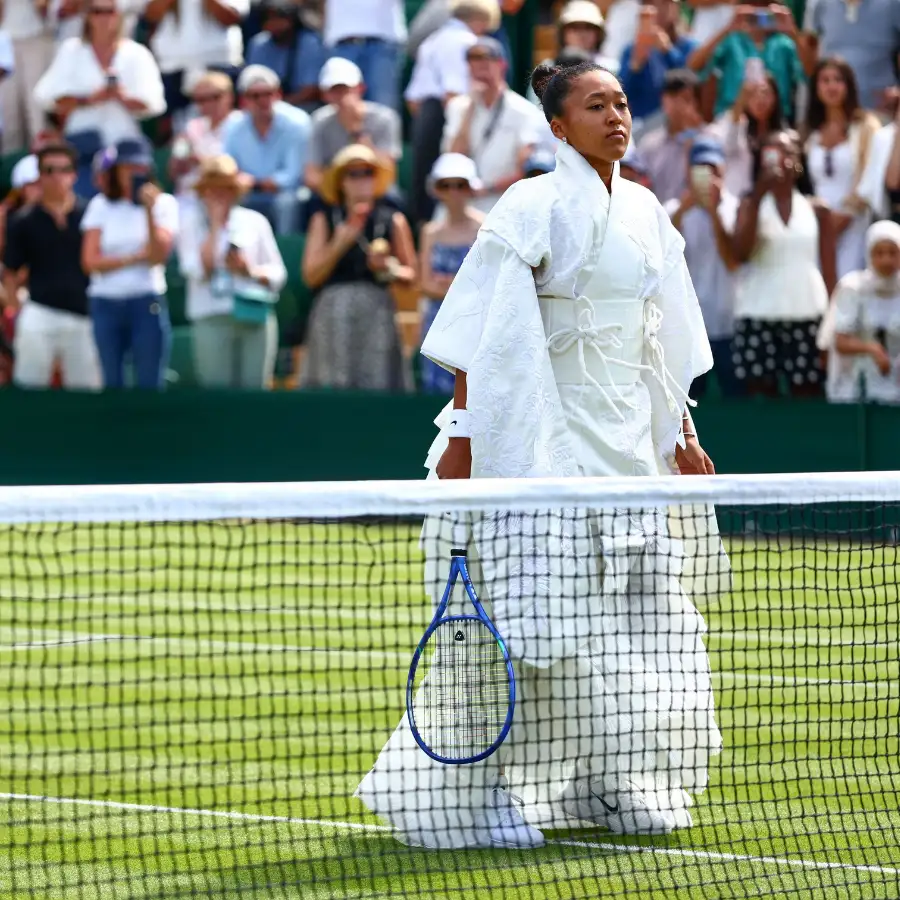
It's only Wimbledon day two as I write, and Naomi Osaka has already made headlines for her on-court fashion, the kimono for her opening match, the shimmering gold Eiffel Tower dress at the French Open. But in 2021, the four-time Grand Slam champion made headlines for entirely different reasons, when she pulled out of doing press conferences citing poor mental health, then withdrew from the French Open entirely after being threatened with disqualification for prioritising her own care.
In a heartbreaking statement at the time, she revealed the long bouts of depression she had suppressed whilst playing at the highest level and the huge waves of anxiety every time she had to face the world's press. Here was a champion, a woman at the top of her game, who had also, for years, been a champion at overriding her own signals. Now her mind and body said no more.
Osaka's story played out publicly, but I would bet every woman reading this will relate. I know I do. The fact is, there is a toxic culture pervading our society, whereby a woman's ability to keep going, to push through, endure and sacrifice despite every cell of her body screaming at her to stop, is celebrated, admired, even taught. You know the phrases. I am guilty of them. "She's a Trojan," I say about my friends. "She's superwoman. A machine." We are worse with ourselves. "I can't afford to stop." "I can sleep when I'm dead," we say, whilst, as in my case, suffering from severe stress eczema or back pain or bursting into tears at the drop of a hat.
The ability to override our signals is one of the most celebrated abilities in modern culture but what is it costing our physical and mental health and what does it take to stop?
In 2007, businesswoman Arianna Huffington found out when she awoke at her desk in a pool of blood. A divorced single mother of two, she had been working around the clock launching the Huffington Post, ignoring signs of chronic sleep deprivation when she collapsed, breaking her cheekbone. It took this horrifying experience for Huffington to finally stop and look at her work life balance. She founded Thrive Global shortly afterwards, an organisation dedicated to beating the burnout epidemic.
It is not hard to find examples of high-achieving women in public life reaching burnout. In 2019, actress Claire Foy said she was taking a highly self-indulgent, her choice of words being a case in point, hiatus from acting, later revealing that back-to-back projects had left her feeling at the end of her rope with severe exhaustion. It took a terrifying panic attack on a motorway, and the discovery of a tumour on her salivary gland, for broadcaster Fearne Cotton to make a change. Only then did she reveal the chronic fatigue she had been normalising for years in a punishing TV career. She is now a well-known advocate for wellbeing and mental health with her Happy Place podcast and festivals.
It is not just famous or high-achieving women who are guilty, however, it is most women. It is probably every woman at some stage in her life, whether that be whilst building her career, motherhood, or the sandwich years of midlife when caring for elderly parents and young adult kids.
Every morning I watch a neighbour hobble painfully to her car. She is a dance teacher and single mother of two, who urgently needs a hip replacement. Her reason for not getting this routine operation? "I don't have time. Who'd look after my daughters?" This culture of overriding, causing what experts call the Era of Exhaustion, does not just happen at work either. It goes on in all spheres of life: domestic, relationships, friendships, parenthood, and manifests in all sorts of ways from people-pleasing to perfectionism.
Every year I fall prey to what I call my Christmas collapse. It normally follows a period of work deadline frenzy, trying to get everything done before the holidays. This striving seeps into my people-pleasing tendencies, leading to a ridiculous, over-reaching, present-buying and hosting frenzy leaving me destroyed by the big day itself. Last year was even worse. Having ignored the warning signs of tearfulness and simply feeling I had hit the wall, I tried to push through anyway and began to have intrusive thoughts, a kind of OCD, that meant come the 27th, I had to go to bed for two days, just to reboot.
A friend of mine ignored her cortisol-fuelled back niggles for so long, she ended up bed-bound for three weeks with myofasciitis, agonising back pain. Determined to never go through that again, she then began the Alexander technique, twice-weekly Pilates and crucially, allowing herself to rest, especially when stressed. Why is it though, that it has to get so bad before we will listen to what our body is telling us? When did we get so stubborn? Brilliant at ignoring ourselves?
Shortly after withdrawing from the 2021 French Open, Osaka wrote a poignant piece for TIME magazine, in which her core message was: "It's OK not to be OK."
Maybe the message should actually be: it's not OK not to be OK and to carry on like we are OK.
What if we just allowed ourselves to stop?