Going Back to the Office in Your Forties Feels Like Exhaling

Going Back to the Office in Your Forties Feels Like Exhaling
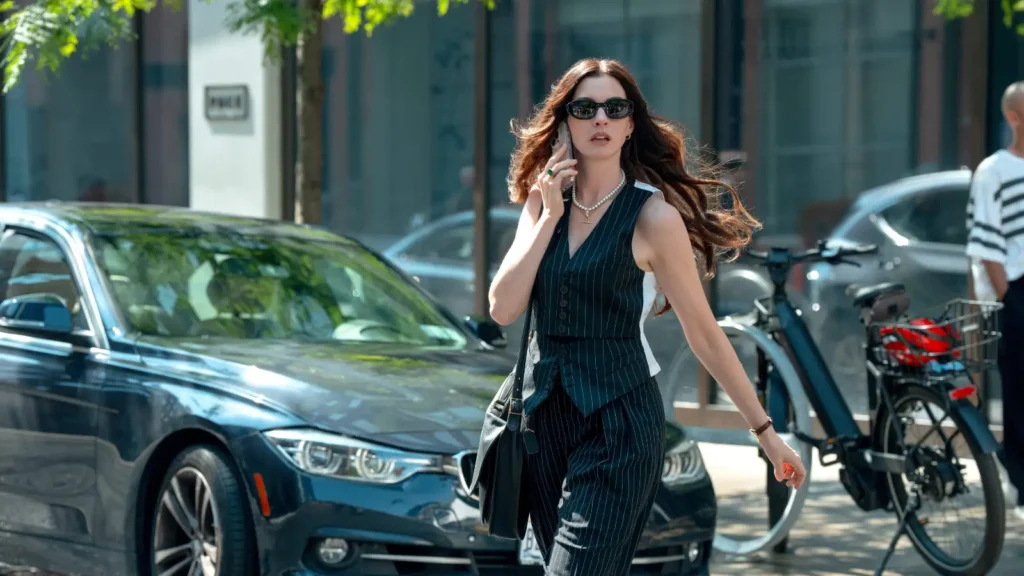
I expected that stepping back into an office job after five years of freelancing from home to be a bit of a shock to the system. But watching Anne Hathaway return to office life with punch as Andy in The Devil Wears Prada 2, I felt something I hadn't expected: recognition.
My first week back, now as a commissioning editor at Guardian Labs, brought an unhinged level of excitement about having a proper chair and free coffee. Also, someone else makes my lunch, and the wifi works. I even love my lanyard.
Obviously, I'm being glib. There's more to this story than the joy of having an IT department and spending half my salary in Atis. Let me explain.
Five years ago, at the age of 40, I resigned as deputy editor of Grazia to go freelance. It was an extremely fun job, with a brilliantly talented team. But like many women who found themselves working from home with small children during Covid, I realised I wanted to be there for dinner. I wanted to collect my kids at 3.30pm and hear about their day. I wanted to stop feeling perpetually half-present at work and at home.
Being freelance was exactly what I needed at that point in my life. My kids, who are now nine and 11, had five solid years of me being at the school gate, at every assembly and school trip. During treatment for breast cancer in 2021, I had the freedom to work around chemo when I could, and rest when I needed to.
I launched a Substack, Well Well Well, about how to be healthy without being a joyless bore, which now has over 10,000 subscribers and taught me more about analytics, branding and strategy than any job. I was, by most measures, thriving.
And yet. Working from home while others were at the heart of the action sometimes felt like there was a party next door. A friend told me recently that I seemed to never take my foot off the accelerator (I did, admittedly, write a book during my second maternity leave, which in retrospect was absolutely bananas). But to me, it often felt like a slower, smaller life than I'd imagined for myself. I missed office life in ways I didn't anticipate. The idea generation, the chaotic energy of a group trying to make something good under pressure, even the gossip. And I missed belonging to something bigger than me.
Mine is a story we're seeing repeated with women in their 40s across the UK, and it has been a long time coming.
The pandemic lit the flame, but the kindling had been building for a decade. The girlboss era of the 2010s glamourised the pivot: going freelance, building a personal brand, monetising your expertise on Instagram. It promised freedom, flexibility and financial independence. And for a while, it delivered. Women like Clemmie Telford built substantial audiences and genuinely thriving careers outside of traditional employment, before quietly heading back to office life. The formula was seductive, but being your own brand, your own HR department, your own accountant and your own IT support turned out to be bloody exhausting.
The arc of female careers is taking a new shape: women who freelanced, built something of their own, or stepped sideways are now finding their way back into employment. Not because they failed. But because something shifted in what they need from work right now. Returnship programmes, structured re-entry schemes for mid-career professionals, have proliferated across finance, law, technology and engineering. A tacit acknowledgement that employers recognise something went wrong. A generation of capable, experienced women left. Now they want them back.
This is not as simple as being about motherhood. Laura is a childfree brand manager in Glasgow who went freelance around the same time I did, at the tail end of the pandemic. "I was approaching 40 and wanted to see what life beyond the office could look like," she says. "I wanted freedom and flexibility, and the past few years have been a joy. I've learned a lot, but I'm ready to go back to the security and familiarity of office life."
In 2013, when I was 32 and a year away from having my first child, I read a quote by former US Secretary of State Madeleine Albright: "I do think women can have it all, but not all at the same time. Our life comes in segments." Now I believe there's no such thing as having it figured out for the long term. It's simply about doing the right thing for you, at any particular point in life.
For me, freelancing wasn't a step back. In fact, I've come back better. The editorial experience I accumulated across a career in magazines is now complemented by everything I learned from making something work on my own: budgets, communication, audience-building. The question is whether employers are smart enough to recognise and reward that. A woman who has grown an audience and kept a business afloat has a skillset that the traditional career ladder simply cannot replicate. She has learned to operate without a safety net. The real test for workplaces now is whether they can see that, or whether they'll keep measuring experience in the old, linear ways that never served women particularly well in the first place.
I love the creative satisfaction of building projects as part of a team again; the back-and-forth, the collective problem-solving. And the 9-to-5 isn't quite what it was pre-pandemic. I'm in the office three days a week, so can take my daughter to school on Mondays and Fridays. I do a nine-day fortnight, with every other Friday free to work on my Substack. Work, it turns out, has also had to change.
Women in their 40s are returning to offices across the country, but make no mistake, we are not picking up where we left off. We are arriving somewhere entirely new: harder-won, more clear-eyed, and with considerably more to offer than we did the first time round.
What to read next