
5 trailblazing women entrepreneurs leading the way in business

5 trailblazing women entrepreneurs leading the way in business
Sara Blakely was getting dressed for a party in 1998 when she cut the feet off a pair of tights to wear under white trousers. The result was smoother, more flattering, and solved a problem she had been quietly irritated by for years. She had no background in fashion, no industry contacts and no investment experience. What she had was a personal frustration that turned out to be universal. Spanx is now worth over a billion dollars.
Whitney Wolfe Herd was frustrated by the power dynamics she had experienced in online dating. Bumble, built on the simple principle that women message first, reached a billion dollar valuation within five years of launch. Anita Roddick was frustrated by an industry that sold women the promise of transformation through expensive, unethical products. The Body Shop became one of the most recognisable retail brands in the world. Oprah Winfrey, Arianna Huffington, Sophia Amoruso: the list of women who built category-defining businesses from a moment of personal dissatisfaction is long and consistent enough to constitute a pattern.
The pattern is this: the most transformative ideas rarely begin with market research or a gap in a spreadsheet. They begin with someone paying close enough attention to their own experience to recognise it as universal. The frustration is the insight. The business is the answer.
It sounds deceptively simple, and in one sense it is. The idea itself, the noticing, the recognition that something could be different, costs nothing. What comes after is considerably harder, and for women, the obstacles between a founding insight and a functioning business remain significantly greater than they are for their male counterparts.
The funding gap that refuses to close
In 2023, female-founded companies in the UK received just 2% of venture capital funding. That figure has barely moved in a decade. All-female founding teams receive less than 2p in every pound of VC investment. The reasons are structural and well-documented: a predominantly male investment community that tends to fund founders who look like previous successful founders, pitch cultures that reward a particular kind of confident, expansive storytelling that women are socialised away from, and a persistent tendency to interrogate female founders on risk while asking male founders about opportunity.
The consequence is that women are disproportionately likely to bootstrap, to grow more slowly, to remain smaller than their ideas deserve, or not to start at all. The businesses that do break through tend to do so not because the barriers were lower but because the founders were more determined, more resourceful, or simply more unwilling to take no for an answer.
Thankfully these barriers are slowly reducing as the infrastructure around female entrepreneurship expands. Angel networks, female-focused funds, accelerator programmes and communities built specifically to connect women with capital and mentorship are all growing. The gap remains vast. But the direction of travel is, at least, the right one.
The AI question
There is a version of the current conversation about artificial intelligence that implies the window for building something new is closing. That the tools, the platforms, the content, the code, are increasingly automated, and that the advantage of starting something from scratch is diminishing as AI makes it possible for anyone to produce anything.
This misunderstands what founding something actually requires. AI can generate a business plan, design a logo, write a pitch deck and produce a financial model. What it cannot do is feel the frustration that Blakely felt getting dressed, or the anger that Eshita Kabra-Davies felt standing in Rajasthan watching textile waste accumulate, or the specific sadness that Lemon Fuller noticed in the women around her who did not know how extraordinary they were. It cannot notice what does not yet exist. It cannot want something to be different.
Innovation, in its truest sense, is a human act. It begins in the body, in lived experience, in the particular emotional response to a world that is not quite working. That is not something that can be prompted or generated. It can only be felt, and then acted on.
In that sense, the rise of AI makes the human instinct to innovate more valuable, not less. The barrier to execution is lower than it has ever been. The tools are more accessible. The distance between a founding idea and a functioning product has shortened considerably. What remains scarce, and what will always remain scarce, is the original insight that makes the whole thing worth building in the first place.
The women who did it anyway
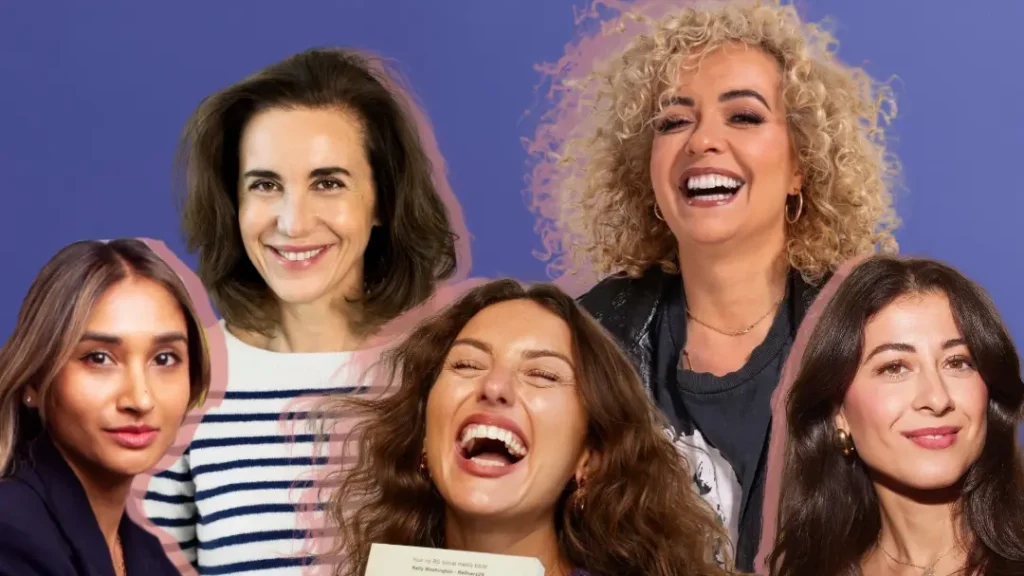
Here we profile five women who represent very different industries, very different journeys, but a single shared starting point: one personal frustration that turned out to be universal.
Mathilde Thomas, Co-Founder of Caudalie
In 1993, Mathilde Thomas was at her family's Bordeaux vineyard when she met a researcher studying the antioxidant properties of grape skin resveratrol. The grape skins, rich in compounds that could be extraordinarily powerful in skincare, were being discarded as waste. Mathilde recognised the opportunity immediately and Caudalie was born from that single conversation.
What started as a mission to create clean, ethical and sustainable products as effective as the natural ingredients they are made from has grown into one of the most respected names in French beauty. Caudalie now operates 50 spas worldwide under the Vinothérapie concept, the first of which opened in 1997 on the family estate where the idea first took root. Mathilde's 2015 book, The French Beauty Solution, became a New York Times bestseller, and she has since been awarded the SKEMA Leadership Award for her contribution to sustainability in beauty and wellness.
Mimi Ikonn, Co-Founder of Intelligent Change
Mimi Ikonn's founding story is more interior than most. Born in Azerbaijan and educated in Canada, she dropped out of college when she realised formal education was not going to take her where she needed to go, and built a career as an image consultant before co-founding Luxy Hair in 2010. By any external measure, she was successful. By her own account, she was living in survival mode.
A ten-day Vipassana meditation retreat shifted something. Mimi returned with a different question: not how to achieve more, but how to live better. Intelligent Change, the brand behind The Five Minute Journal and the Productivity Planner, grew from that reorientation. Backed by behavioural science and built around the idea that small daily habits create lasting change, it has become a globally recognised platform for mindful living. Mimi's frustration was with the version of success that left her feeling empty. The solution she built has helped millions of people redesign their relationship with their own time.
Eshita Kabra-Davies, Founder and CEO of By Rotation
Eshita Kabra-Davies was on her honeymoon in Rajasthan, her birthplace, when she saw the scale of textile waste produced by the fast fashion industry up close. The experience was impossible to ignore and equally impossible to resolve through individual consumer choices alone. She needed a systemic solution.
By Rotation, launched in 2019, is that solution: a peer-to-peer fashion rental platform that allows users to borrow from and lend to one another, refreshing their wardrobes without buying more and generating income from what they already own. The platform now has over 375,000 users globally, with more than 80,000 listings valued at over $45 million. The top lenders earn upwards of £4,000 a month from their existing wardrobes. Eshita's frustration with overconsumption became a business model that makes sustainability the economically rational choice rather than the idealistic one.
Lemon Fuller, CEO and Founder of Lemonade Dolls
Lemon Fuller spent years as a dancer and choreographer, working with artists including Beyoncé and Justin Bieber. What she kept noticing, in rooms full of extraordinary talent, was the disparity in confidence between the men and women around her. The women were just as talented. They did not always know it.
Lemonade Dolls, launched in 2019, was her response: an inclusive lingerie subscription brand described by Lemon as a love letter to anyone struggling with their confidence. Made from 100% recyclable materials and available across a genuinely size-diverse range, it has become the UK's fastest growing lingerie brand. For every £100 spent on the website, the brand donates underwear to displaced female refugees. The frustration that started it was personal. The brand it became is for everyone.
Daisy Morris, Founder of The Selfhood
Daisy Morris identified a gap hiding in plain sight: professional women were building online audiences without the tools, knowledge or community to do it with any real confidence or strategy. The Selfhood, the social media consultancy and community she founded, exists to close that gap, combining data with emotionally intelligent creative thinking to help brands and individuals build online communities that feel genuinely human.
Daisy has worked with Meta, Apple, Gucci and TEDx, and The Selfhood runs regular events and co-working sessions for professional women navigating an increasingly hybrid working world. The organisation also fundraises with YoungMinds UK through their campaign Check Yourself Before Your Notifications, which encourages mindful social media use.
Five industries. Five moments of personal frustration. Five businesses that turned out to be answering a question far more people were asking than anyone had acknowledged.
The barriers between those founding moments and functioning businesses are real, and for women they are steeper than they should be. The funding gap is not a myth. The structural disadvantages are not imaginary. But the distance between a personal frustration and a business that changes an industry has never been shorter, and the tools to close that distance have never been more accessible.
What has not changed, and what AI will not change, is the requirement for the original human insight that makes the whole thing worth building. The noticing. The refusal to accept that this is simply how things are. The decision to build the answer rather than wait for someone else to.
That has always been the starting point. It still is.
What to read next


