
Advertisement


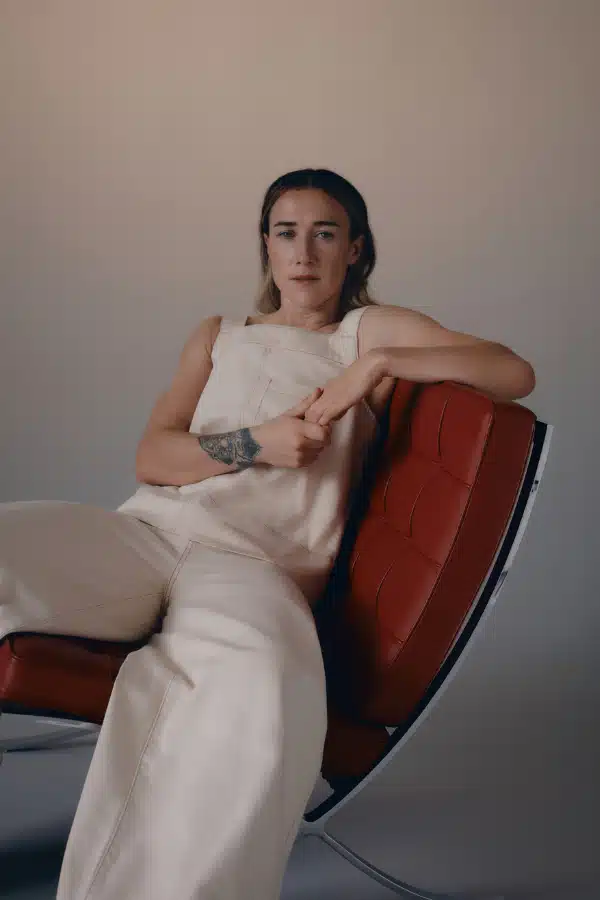
The Quiet Authority of Lucy Bronze
Lucy Bronze’s name wasn’t on the list at the tiny, South London members' club her agent had told me to meet her at. I was early. There was no booking, and the guy on the front desk didn’t know her name. When England's toughest Lioness hurried through the door, head down, bun pulled tight, I hardly had a chance to raise my hand in hello. It was a mildly disarming start. Bronze clearly had no idea who I was, and she barely scanned the room to try and find out.
It wasn’t exactly the air-kissing, overly demonstrative opener to an interview that I’ve had to endure with others in the limelight. I trotted after her as quickly as I could to a quiet table in the back corner, one she clearly knew she wanted. We sat down.
I tried some small talk. It didn't quite land.
As I unpacked my notes and switched my phone to record, I searched for some conversational common ground. The Australian Open. Two extraordinary matches had just happened within the previous 24 hours, Djokovic and then Nadal. I'd ridden both rollercoasters. Lucy was annoyed that she'd only caught up with them on TikTok. Something shifted; and...breathe. Sport, of course, was going to be our shared language. She accepted my small peace offering and both of our shoulders dropped.
What followed over the next hour was less an interview than a slow unfolding. Lucy Bronze does not hand herself over easily. She is almost entirely the opposite of what I expected from a woman who has won 5 Champions League titles and spent the better part of two decades being publicly brilliant, not to mention winning Euro 2025 with a fractured tibia.
"I didn't used to be this tough, brave person that I know today," she tells me, as part of a story about how she always sat at the back of the class at school, knowing the answers but never giving them. She was bullied and told nobody. There is no performance in Lucy’s reveal, she’s just recognising some of her own life’s truths.
Having read pretty much every article about Bronze before heading to meet her, I already know her middle name is Tough, it was given to her by her mother, who had grown up as Miss Tough, a teacher at the front, ironically, of many classrooms. Her aunt, wait for it, was Sergeant Tough, the first woman in the police force to wear trousers (there is so much to unpick here, alas for another story), after getting fed up of having to hike up her skirt to jump fences when chasing rogues on the street. Despite this obvious tough/footballing link, I’m more interested in what sits on its other side: softness and vulnerability.
"Yeah," she quickly concedes, "I think vulnerability is something that I struggled more with. It was easy to put on a facade and be tough and not cry, not show emotion." She shares how she was rejected many times in her youth, including, at first by the England team, after which point, she packed her bags and headed to the University of North Carolina, on a scholarship to study sports science, as well as to play on the acclaimed Tar Heels college team.
She admits that her demeanour throughout these formative years, her shield perhaps, was an icy shade of standoffishness. One that led her first England captain (she was eventually called up) to see her as intimidating, rather than the other way round. "I never showed a vulnerable side, I was very self-driven. I wanted to be the best. I am still very determined." I kind of know how that England captain felt.
So, what about her softness then? My gut tells me Lucy is warm to the core. You can tell when she makes eye contact. Today she can absolutely appreciate the benefit of connecting deeply with her teammates.
I mention Owen Eastwood, the performance coach who worked with the men's England squad towards their own 2020 Euros finals, leveraging ideas around building a sense of belonging that are rooted in his own Maori heritage. Lucy listens, and something settles in her face. She hadn't heard his name, but she knew the idea. "A couple of years ago," talking about her own squad trying to build stronger connections, "it was more like, sit in a circle, here's a question, answer it," she shares.
"But sometimes that kind of activity feels like forcing people to share things they're not comfortable with." These days, the Lionesses spray paint together, and do puppy yoga. They put the team in environments where nobody is playing for England in that moment "to find a shared rhythm". It all sounds very harmonious.
And then she drops the most astounding comment of the entire interview: "We don't all like each other."
In isolation this statement reads as surprisingly blunt. But Lucy is not someone who speaks without consideration, or context. When she explains what she means, I’m left feeling that she is sharing this truth with radical generosity. "On the pitch, you're looking at each other not always as a friend but as people you care about. You know their story," she nods her head, perhaps remembering some of the best as we chat. "You know their emotions, and care regardless of your feelings towards each other's opinions, abilities, or performances."
In Lucy’s world liking is optional, care is not. Perhaps that’s a lesson for us all.
What I take away from Lucy's candour is a blueprint for her own leadership. She is that player, the one the team orbits around, and she is beginning to really relish it. With Serena (Wiegman, the England manager since 2021), she is building something that feels deeply safe without needing to be exclusively close. Harmony and duty are not the same thing, I realise she’s trying to say. I get the feeling every member of the team, herself included, has felt the cost of being a woman who is expected to achieve both at once.
When she talks about former players who weren't happy in the England squad, her face darkens a bit. "It hurts me personally that people felt uncomfortable or not happy playing for England," she admits. "It should be the happiest moment of your career."
She is clearly working hard to ensure this is a thing of the past. Lucy is, at thirty-three, the player actively telling younger teammates she wants them to take her place. "I happily tell them, you're the one who's going to take my spot. I want you to do that because I've had my moment, I’m so content with my career. I'm just enjoying it now," and crucially, for a leader who is committed to buoying her team, "I'm getting enjoyment out of helping you."
I find myself thinking that every workplace needs a Lucy Bronze in it. "I don't need the recognition," she finishes off. "As I know inside, I've helped them all." I wonder, listening to her, whether this is what it looks like when someone has genuinely solved the tension between individual excellence and collective responsibility. Not dissolved it but solved it. Lucy is still ruthlessly self-driven. I'm pretty sure she still runs through walls (her term). But perhaps, with Brazil on the horizon and whatever comes after it, she is learning that walls are easier to run through in company, and that getting people to run with you requires you to let them really see who you are as a person. Even, occasionally, as a player who doesn't need to know or win it all.
Lucy has absolutely helped herself over the years too. In part, thanks to her brilliantly autistic brain.
While she didn't receive a formal diagnosis until her late twenties, she'd been living with the knowledge informally for much longer. "My mum always said I was autistic," she tells me matter-of-factly. What she didn't have, until recently, was the language for how her mind worked and what it meant for the people around her.
"I used to think I was just being helpful," she laughs. "People would say, 'You never let anyone else figure things out for themselves.'" I’m assuming she means on the pitch. In her head, she’s just providing answers to complex problems as quickly as possible, to help everyone get to the finish line. I have a sense that this isn’t always appreciated by those around her, though it certainly gets the job done.
What strikes me most is not how she describes the diagnosis but how she carries it: as information rather than identity, as explanation rather than excuse, and above all as something that belongs to her rather than something that happened to her. She is Lucy because she is autistic. Not in spite of it.
Last summer at the Euros, it was Bronze who received a note from Wiegman standing on the sidelines; specific, hand-written advice, I assume on how to best defeat the Spanish. "She knew my brain would solve this puzzle the quickest. [Autism helps me] figure the game out like chess. I see the whole match as a chessboard." Without needing to further explain but maybe helping me get to her own point directly, "It's all like a maths equation to me."
Despite maths being the subject that felt like ‘therapy’ at school, it is fashion that’s most recently stolen her heart.
Just last week, the second Lucy Bronze for Aligne collection launched. Aligne is a relatively new brand, launched post-Covid, no fanfare, quietly gaining traction around the edges of one of the most competitive, and ruthless industries. On its website the mission is clear: Our story is shaped by strong and confident women. Women who are going places. We are determined to create something bigger than just beautiful clothing. We make clothes that hold their own. Considered and assured pieces to live boldly in. Someone give the marketing team a raise; the Lucy Bronze partnership is inspired.
When you look at her collection, all buttery yellows, soft tailoring, and a set of ‘just so’ spring knits, I assume style must have been a secret passion of Bronze’s for many years. Wrong again.
When Aligne approached her, Lucy wasn't sure. Fashion had never felt like a space that was hers. "The stereotype of what fashion has seen us as," she says, meaning women's bodies as spectacle rather than subjects – sportswomen – didn’t sit naturally. After some time to think though (usually done in her at-home, infrared sauna) she landed on the challenge sewn into it all: the unfamiliarity was precisely what made this interesting. The first collection was a learning curve in all senses of the term. She learnt to say no to pieces that she didn't believe in. "Maybe five years ago I would have just been like, 'Yeah, that's nice.’" She pauses. "Actually, being brave enough to say no, that didn’t used to be me. It’s something I've learned on the pitch and can now bring here."
Midway through this part of the conversation she opens her phone and shows me a pale yellow leather hoodie, just a rough sketch at this point, from this spring collection. It is her favourite piece (£425, to be fair, most pieces sit around the £100 mark). She is very excited about wearing it when the weather improves. I say very excitedly. Maybe that’s me projecting. She is faintly excited, like she is about most things she feels passionately about, I realise: no fanfare, just a kind of focused pleasure.
It strikes me that Bronze has been steadily resetting, evolving herself, in various ways actually, for her entire career.
Six knee surgeries. A leg that hasn't straightened in a decade. Having to accept (like Djokovic, at the start of our meeting), that what she has now on the pitch is different, but still plenty enough to create wins. "I'm not the best player on the team anymore," she admits, "but I can still do something." I don’t challenge her on this enormous understatement because she quickly follows that statement with something just lovely.
"If you watch the second Euros, even though I was injured and I played worse than I did 3 years earlier, (Covid messed the years about), you’ll see me smiling a lot more. I was at peace."
I believe her. And I think that peace, rather than closing things down, has opened things up for Bronze. As well as this second Aligne collection, there is her seat on the board at the Professional Footballers’ Association, where she is working on decisions that shape the future of the game, and most recently, a new role as an ambassador for the National Autistic Society. Where I assume she’ll be facing head on a subject she once had no language for and turn her knowledge into support she can share with others.
I walk back out into the rain and think again about that awkward start to our conversation. The way she came through the door without any theatre, how she found the quietest table at the back, then sat down and waited for the conversation to find its own level. Lucy Bronze MBE is a person so settled in who she is today, that she has nothing left to prove. She is just a woman at the beginning of whatever comes next, who is unafraid of not yet knowing what that is. And I like her very much.
Find Lucy Bronze's newest collection at aligne.co


