
Advertisement

How Getting Dressed Has More to Do with Big Decisions Than You Might Think

How Getting Dressed Has More to Do with Big Decisions Than You Might Think
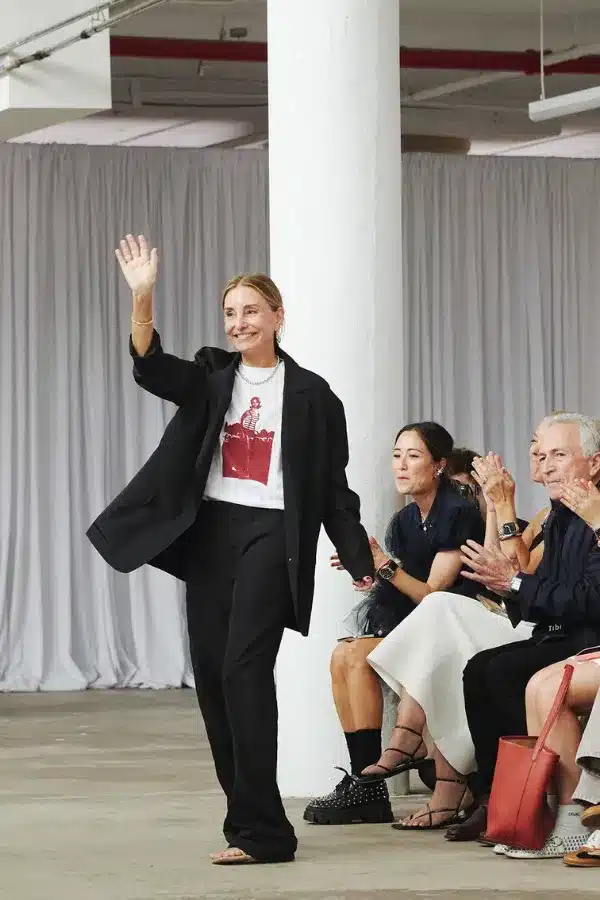
Now, Amy is also an author. In her new book, Almost Reckless: A Creative and Pragmatic Approach to Taking Risks, Smilovic not only fuses her commercial and sartorial lessons, she makes the case for risk-taking. It is, Amy believes, not a personality trait but a skill. And that means it can be learned, practised and developed over time.
In this exclusive extract, she begins somewhere most of us would not expect: the wardrobe. Personal style, she argues, is not vanity. It is communication. And for anyone who has ever wanted to take a bigger risk in their career, their relationships or their life, learning to take smaller ones first, in an arena where the stakes are relatively low and the feedback is immediate, turns out to be a surprisingly powerful place to start.
You’ve probably been taught that personal style is a way to feel good about yourself rather than to truly become a better person. I disagree. We have only three ways to communicate who we are, after all: through our words, through our actions, and through our visual presentation. Your style is one-third of your means of communication, and because visuals speak louder than words, and actions often go unseen... you can understand the importance here. Personal style is a statement, and a powerful one, about who we are.
When you understand who you are, when you are capable of controlling your visual narrative to match your words and your actions, you become a great communicator, even if to no one but yourself. Getting to this stage is immediate for some; for others, not so much. There are rules, in a sense, but some people can pick them up intuitively. What I know for certain is that, at Tibi, when we started communicating the idea of knowing one’s adjectives, how to mix fabrications and colours, and what details to look out for in clothes to communicate chill, modern, and classic, people initially wrote and told me, “You’ve made my life easier. I get dressed so much faster. Thank you.”
After spending months in the closet, applying their newfound knowledge, they level up their comments: “You’ve saved me so much money. I don’t make so many buying mistakes. In fact, I make very few. I’m wearing what I buy a lot. People stop me everywhere and tell me they love my style, my whole vibe. Thank you.”
But once they get in some real hours of practice (maybe not the full Malcolm Gladwell ten thousand, but you get the gist), the letters move to an entirely new level. “I’m completely changed. I’ve never felt so content, my [friends, spouse, kids] thank you. I’ve just [quit, changed] my job. I’ve never felt so content not knowing what’s next but knowing that if it doesn’t work, something else will. And somehow it all started with an oversized blazer. Thank you.”
How is it that no one has figured this out before — that it’s not about creating a uniform for yourself and it’s not about saying “F**k it all, I’ll experiment like mad,” but about doing some initially hard work, stopping to understand, try, experiment, test, and learn? I don’t know. But the payoff? The payoff isn’t a beautiful new you. It’s simply finding you, removing the discontent when your words, visuals, and actions are at odds. Finding the ease.
I have received many messages over the past few years from those who’ve experienced a horrific tragedy, such as the loss of a child, a spouse, or someone they simply loved. And somehow, the act of getting dressed and wearing Tibi comforted them. They wanted me to know this.
In these messages, people couldn’t identify the source of this sense of consolation. It certainly wasn’t because they “looked their best” at a bad moment. It also wasn’t even the simple comfort of wearing their favourite item in uncertain times.
Putting on that item, the one that they knew was right for that moment, gave them a sense of control at a time when they had to give everything else up to fate. When there is friction between what you’re trying to say and what is actually being communicated, when you don’t think critically about what is right for the moment, it creates a sense of unease. Anyone who’s tried to speak a new language or witnessed a toddler meltdown knows the frustration of not being able to communicate.
But when you view getting dressed through the lens of critical thinking, of aligning what you present outwardly with what you mean to say, the unease clears away. You gain a sense of control over yourself and what you are saying. And the more in control of yourself you feel, the less need you feel to control every situation. Moreover, to be in control is to be content, because how much we believe we control a situation —our sense of locus of control— directly impacts our well-being.
Using that critical thinking, having a logical framework of principles around fashion and personal style, which is so historically subjective, is mind- settling.
Try it. See what decisions you make. See what you learn.
Almost Reckless: A Creative and Pragmatic Approach to Taking Risks by Amy Smilovic is out now. If your wardrobe is where you practise, consider this your warm-up.
What to read next



Advertisement

Advertisement
