Why Some Female Friendships Do Not Survive Who You Become

Why Some Female Friendships Do Not Survive Who You Become
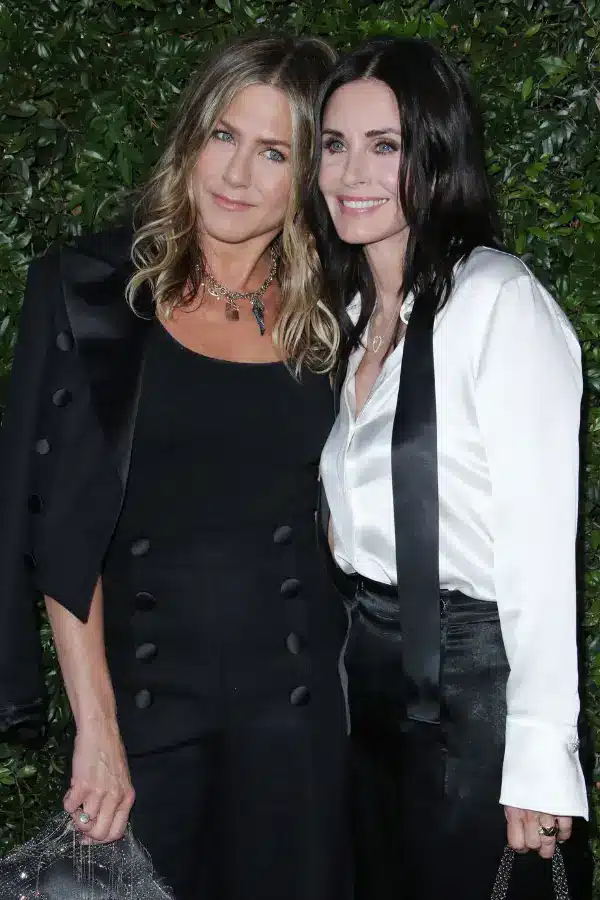
What does the friendship between Jennifer Aniston and Courteney Cox have in common with that of Anne and Amanda from BBC sitcom Amandaland?
On the surface, not much. One pair are globally famous actresses whose friendship has endured decades in the spotlight. The other are fictional mums locked into a dynamic where one assumes intimacy and the other has never quite accepted her as an equal, let alone a BFF.
But both friendships raise a question many of us would rather avoid: does every friendship contain a power dynamic? (Spoiler alert: yes, it does). Which raises perhaps the bigger, even more uncomfortable question, what happens when this dynamic changes?
On paper, Jennifer and Courteney look like equals: two highly successful women who became famous together and have remained side-by-side for decades. But look more closely and different forms of power begin to emerge. Jennifer became a cultural phenomenon in a way few actresses ever do – the most copied haircut in the world, years of tabloid fascination around her relationships and heartbreak. Courteney, meanwhile, has occupied a different kind of celebrity: equally successful, equally beautiful, but with a degree of privacy Jennifer never really has. Courteney started a family. Jennifer became the subject of endless speculation about not doing so. Different forms of power. Different moments where one may have looked at the other and thought: I wouldn't mind some of that.
Let's leave Hollywood for a moment and head to South Harlesden.
Chaos ensues in Amandaland when Anne accidentally goes viral after an Instagram post about her peace lily takes off. Amanda, whose entire personal brand depends on being influential, doesn't take kindly to Anne's newfound fame. Anne's role, until now, has simply been to orbit Amanda, admiring her. Now she's the one being admired. Oh dear.
If we strip away the sitcom absurdity, we're left with something many of us can recognise: every friendship contains its own balance of power. The trouble often starts when that balance is suddenly thrown off.
Just the thought of power dynamics within a friendship can feel a bit ick. Which is odd, really, because when it comes to most other forms of relationships it’s a given.
In workplaces, we’re pretty open about power dynamics. We acknowledge them, analyse them, complain about them. In some ways they’re even useful because they help us understand where we sit in the hierarchy, where our own power lies, where we might gain more of it and where we need to avoid losing it.
Even in romantic relationships we’re conscious of power. ‘He/she wears the trousers’ might be the most outdated and unsubtle version of this, but beyond those clichés we’re often surprisingly comfortable discussing the different kinds of power each partner holds: who earns more, who’s more organised, who’s more emotionally expressive, more romantic, more laidback, who carries the mental load, who gets the final say over where Christmas is spent. We almost assume that romantic relationships contain imbalance, negotiation, compromise, dependency, hierarchy, trade-offs and passive-aggressive WhatsApp messages about who should know the Ocado password.
Female friendships, meanwhile, are supposed to transcend all that domestic stuff. Friends are supposed to be equals. Cheerleaders. Safe havens from hierarchy and competition.
When I put this idea to Dr Anna Machin – evolutionary anthropologist, broadcaster and author of Why We Love: The Definitive Guide to Our Most Fundamental Need – she agrees that friendship is one of the few relationships where many of us still resist the language of power entirely. “Our friendships are supposed to be a zone of relaxation, equality and no judgement,” she told me. “The place where we can be most ourselves, so bringing power into that relationship feels wrong.”
And yet most of us can instantly recognise the roles that get created for us in friendships. There’s the organiser. The glamorous one. The emotionally dependent one. The successful one. The one everybody calls in a crisis. The socially magnetic one. The stable one. The chaotic one.
The existence of power dynamics isn't really the surprise. The surprise is how quickly friendships can feel different – or collapse entirely – when those dynamics begin to shift.
Midlife changes everything. As well as offering us numerous other fresh hells to contend with, it seems to specialise in these redistributions of power.
One woman gets a post-divorce glow-up and suddenly occupies a new confidence. Another finally has the baby she thought might never happen, and the friendship tilts because one of you is now navigating poo explosions and the other is not. Somebody goes sober. Somebody becomes successful. Somebody is made redundant. Somebody gets sick. Somebody starts running ultra marathons. Somebody discovers the confidence that was missing in her twenties and thirties. Somebody else loses it completely.
None of these shifts are really about the events themselves. They are about status, confidence, identity and how we see ourselves in relation to other people. The woman who was once struggling may suddenly be thriving. The woman everybody admired may find herself feeling left behind.
And suddenly the friendship that worked perfectly for five, ten, twenty years begins to feel weird.
A few years ago, there was a throwaway moment in Motherland – now continued in Amandaland – where Anne (hapless Anne who can barely organise a cake stall at a school fete) casually reveals that she used to be Head of Product Development at GlaxoSmithKline Worldwide. Amanda is confused. She thought Anne worked at Greggs. And in this we get a little nugget about the friendship dynamic.
Perhaps Anne is able to take on the role as Amanda's chief admirer precisely because she held her own power elsewhere: professional kudos and, presumably, a salary to match. In real life, power moves constantly across different categories: beauty, confidence, motherhood, money, emotional stability, career success, social visibility, desirability, health, intellect, how loved we are outside the friendship.
Machin also points out that these dynamics are rarely fixed. “Who is dominant may change depending upon the environment,” she tells me. “At work or when paying in a restaurant, the more economically successful may hold the power, but in a social situation the more socially confident will come to the fore.”
It may be one reason friendships like Jennifer and Courteney's survive. Neither woman appears to have held all the cards at the same time.
Talking about power in this way can feel like we're reducing friendship to a balance sheet. But power dynamics don't disappear simply because we'd rather not acknowledge them.
Friendships often dissolve more ambiguously than romantic relationships. There is rarely a neat story of betrayal, incompatibility or infidelity. As Dr Anna Machin points out, we should allow ourselves to grieve friendship endings too. Part of that grief may come from how difficult they are to explain, even to ourselves.
Sometimes nobody did anything terribly wrong. One woman changed. The other changed too. Life rearranged the furniture a little, and the friendship stubbed its toe in the new layout.
And perhaps that's the real distinction when it comes to the friendships that endure: not friendships without power dynamics, but friendships that are able to survive them changing.
What to read next